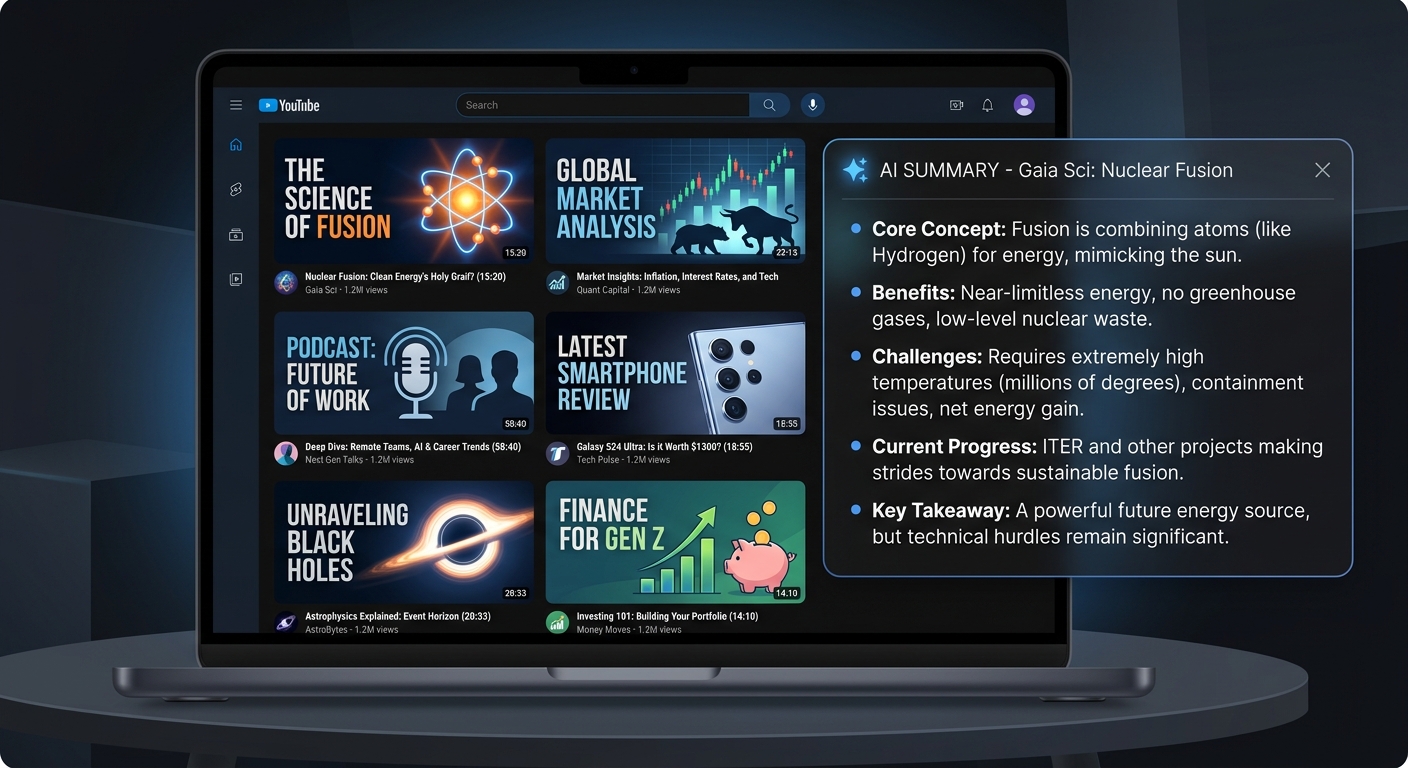
10 YouTube Channels That Are Better as Summaries Than Full Watches
Not all YouTube content is made equal. Some channels are built for the lean-back experience — the editing, the pacing, the personality is the product. Skip those in favor of a summary and you’ve missed the point.
But then there’s a different category: channels where the value is almost entirely in the ideas. The information density is high, the runtime is long, and the truth is that most viewers would get 90% of the benefit from a well-made summary in 10% of the time.
These are those channels.
1. Huberman Lab
Episodes run two to three hours. The research is solid. The insight-per-minute ratio on the summaries, however, is extraordinary — protocols, mechanisms, and actionable takeaways that you can actually use. Nobody needs to hear the full disclaimer section four times.
2. Lex Fridman
Three to four hour conversations with researchers, engineers, and thinkers. Lex is a patient interviewer — sometimes too patient. The best exchanges are buried inside hours of context-setting. A summary surfaces the signal: the key claims, the sharpest exchanges, the moments worth returning to.
3. Y Combinator
Startup school talks, founder interviews, office hours recordings. This is dense, practical knowledge — fundraising strategy, product thinking, go-to-market mechanics. The format is utilitarian. A summary makes it searchable and scannable in a way the original isn’t.
4. Kurzgesagt – In a Nutshell
These are already tight (10–17 minutes), but the information layering is complex enough that a structured summary — concept, mechanism, implication — is genuinely useful for retention. Especially for the science-heavy ones.
5. Economics Explained
25 to 40 minute deep-dives on monetary policy, trade dynamics, national economies. Excellent research, clearly explained — and a format that summarizes beautifully into a few tight paragraphs without losing the core argument.
6. Patrick Boyle
Finance and economics with a dry wit and serious depth. Videos run 30–60 minutes. The actual insight is concentrated in the first and last 10 minutes; the middle is supporting evidence. A summary gives you the thesis and the key data points without the walkthrough.
7. Cold Fusion
Tech and business history — how companies rose, failed, or transformed industries. Narrative-driven but research-dense. Good for summaries because the story structure makes the key moments easy to extract: the turning point, the decision, the outcome.
8. TED and TEDx
The flagship 18-minute talks are already edited for density. The longer TEDx recordings, however — 45 to 60 minutes — vary wildly. A summary filters for the talks worth your full attention versus the ones that deliver the idea in two paragraphs.
9. Real Engineering
Engineering deep-dives with excellent production. 15–25 minutes per video, high concept density. Summaries are useful here primarily for retention — the information is accessible in the video, but it disappears fast without a structured recall.
10. Bloomberg Technology
Market updates, tech news, interviews with executives. Frequently event-driven and fast-moving. This is the channel where staying current via summaries makes the most sense — you need the information, not the broadcast format.
The common thread across all ten: the ideas travel well. They don’t lose much in translation. And the time you save is real.