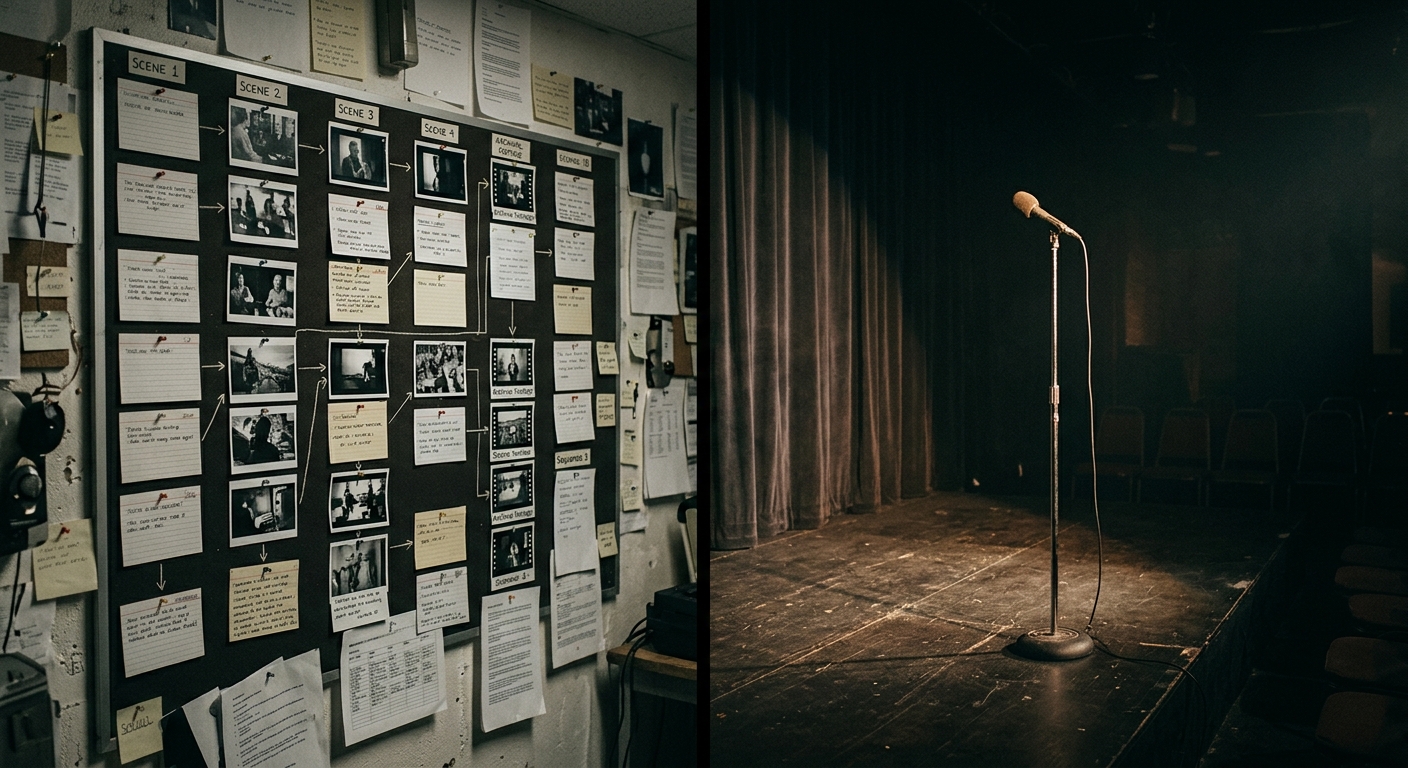
Why Documentaries Summarize Beautifully and Comedy Specials Don't
Two hour-long videos, both worth watching, both a real time investment — and a summary of one keeps almost everything that mattered, while a summary of the other keeps almost nothing worth having. A documentary and a comedy special can be the exact same runtime and land at completely opposite ends of how well they compress. The reason isn’t quality. It’s structure.
Why Documentaries Compress Well
A documentary is usually built around a claim, a sequence of evidence, and a conclusion — the structure exists specifically to be followed and retained, because that’s how the format persuades or informs in the first place. Facts, dates, named sources, a throughline connecting one section to the next: all of it is exactly the kind of discrete, extractable content a summary is designed to capture. Watching the full documentary adds texture and craft, but the actual information usually survives the compression intact, because it was built to be extracted in the first place.
Why Comedy Specials Don’t
A comedy special’s value isn’t the information in the jokes — it’s almost entirely in the delivery: timing, pacing, the buildup to a punchline, the crowd’s reaction shaping how the next bit lands. Strip that out and describe the premise of a joke in a sentence, and you get something technically accurate and completely unfunny. The joke wasn’t the setup-and-punchline text. It was the performance of it, and performance is exactly the part a text-based summary has no way to carry.
The Actual Difference
Documentaries are built to inform. Comedy specials are built to be experienced. A summary is fundamentally a compression of information, so it does well with content whose value is informational and struggles with content whose value is experiential — timing, delivery, the specific rhythm of a bit that would go stale the moment you retell it flatly.
Documentaries have a throughline a comedy set often doesn’t. Even a loosely structured documentary is usually building toward something. A stand-up set can jump between entirely unrelated bits with no throughline connecting them, which means a summary risks flattening ten separate, self-contained jokes into one shapeless paragraph that captures none of them well.
Retelling degrades comedy in a way it doesn’t degrade facts. A fact survives being restated in different words. A joke usually doesn’t — the exact wording, the pause before the punchline, and the specific rhythm are often the entire mechanism, and none of that survives a paraphrase.
What This Means Practically
A summary is a genuinely good substitute for a documentary when time is tight, because the format was built to survive exactly that kind of compression. A summary of a comedy special is closer to a spoiler than a substitute — it tells you what happened without giving you any of what made it good, and it can actively ruin the timing if you do end up watching the special afterward.
The Bottom Line
Not all long-form video compresses the same way, and runtime alone doesn’t predict how well a summary will serve you. The real predictor is whether the value lives in the information or in the performance of delivering it. Documentaries hand a summary almost everything it needs. Comedy specials hand it almost nothing that matters.